
How does a firewall work
You open your laptop…
Connect to WiFi…
Start browsing your favorite website…
Everything feels normal.
But here’s the truth 👇
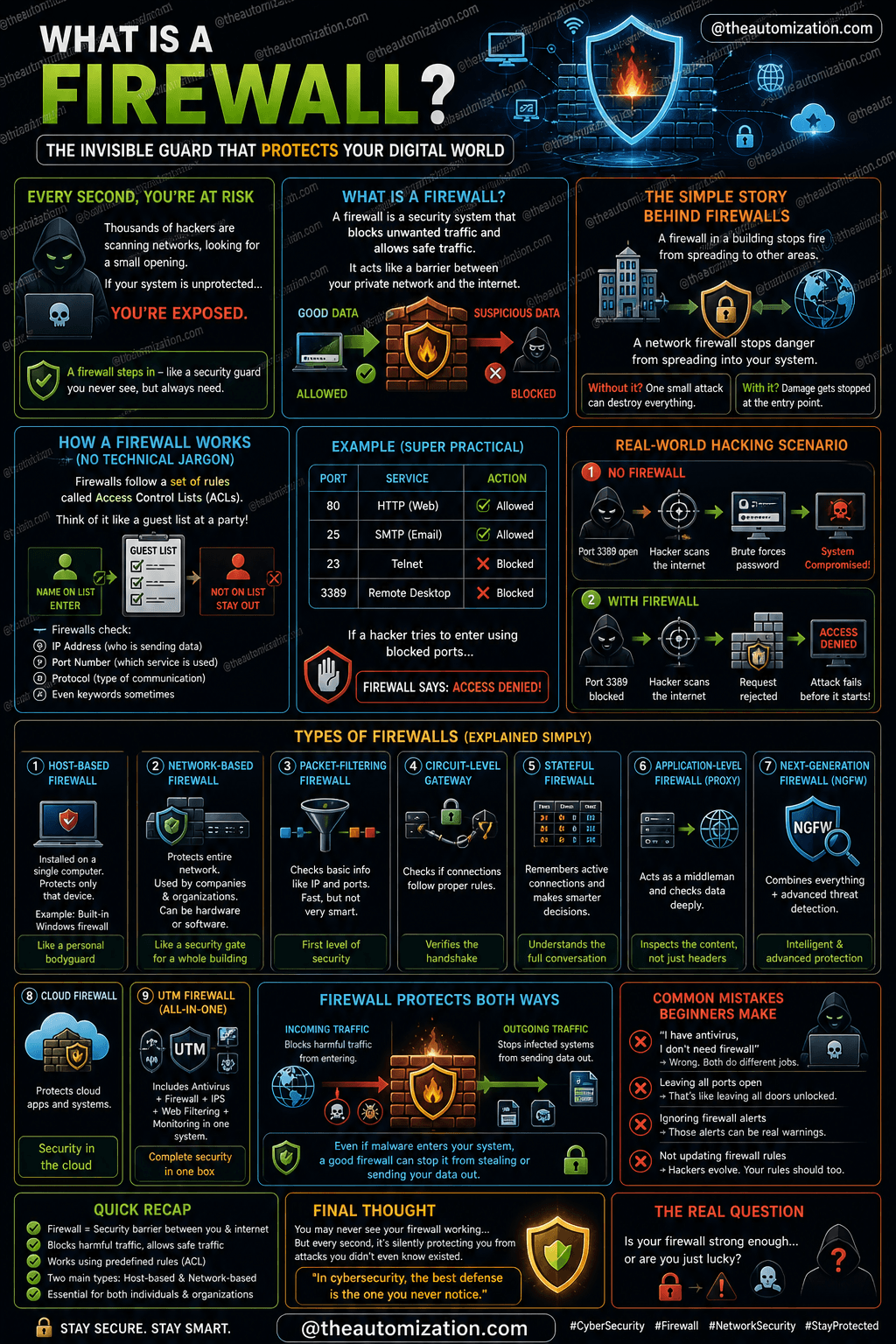
At the same exact moment, there could be thousands of hackers scanning networks, looking for a small opening.
And if your system is unprotected…
💥 You’re exposed.
That’s where a firewall quietly steps in — like a security guard you never see, but always need.
🌐 So… What Exactly is a Firewall?
Imagine your home.
You don’t let every stranger walk in freely, right?
A firewall works the same way — but for your network.
👉 A firewall is a security system that blocks unwanted traffic and allows safe traffic.
It acts like a barrier between your private network and the internet.
Simple words:
Good data → Allowed ✅
Suspicious data → Blocked ❌
🧠 The Simple Story Behind Firewalls
Let’s make it super easy.
Think of a building on fire.
A real firewall in a building stops fire from spreading to other areas.
Now imagine the internet as that “fire”.
A network firewall stops that danger from spreading into your system.
👉 Without it?
One small attack can destroy everything.
👉 With it?
Damage gets stopped at the entry point.
⚙️ How a Firewall Actually Works (No Technical Jargon)
Behind the scenes, a firewall follows a set of rules.
These rules are called:
👉 Access Control Lists (ACLs)
Think of it like a guest list at a party 🎉
Name on list → Enter
Not on list → Stay out
Firewalls check things like:
IP address (who is sending data)
Port number (which service is used)
Protocol (type of communication)
Even keywords sometimes
💡 Example (Super Practical)
Let’s say:
Port 80 (web) → Allowed
Port 25 (email) → Allowed
Port 23 (telnet) → Blocked ❌
Port 3389 (remote desktop) → Blocked ❌
👉 If a hacker tries to enter using blocked ports…
🚫 Firewall says: “Access Denied.”
🧨 Real-World Hacking Scenario
Let’s make this real.
🚨 Scenario 1: No Firewall
A company leaves port 3389 open.
A hacker scans the internet → finds it → brute forces password → enters system.
💥 Result: Full system compromised.
🛡️ Scenario 2: With Firewall
Same situation.
But firewall blocks port 3389.
Hacker tries → request rejected instantly.
👉 Attack fails before it even starts.
🧩 Types of Firewalls (Explained Simply)
- 🖥️ Host-Based Firewall
Installed on a single computer
Protects only that device
Example: Built-in Windows firewall
👉 Like a personal bodyguard
- 🌐 Network-Based Firewall
Protects entire network
Used by companies & organizations
Can be hardware or software
👉 Like a security gate for a whole building
💡 Pro Tip:
Smart companies use both together for maximum protection.
Here’s where things get interesting…
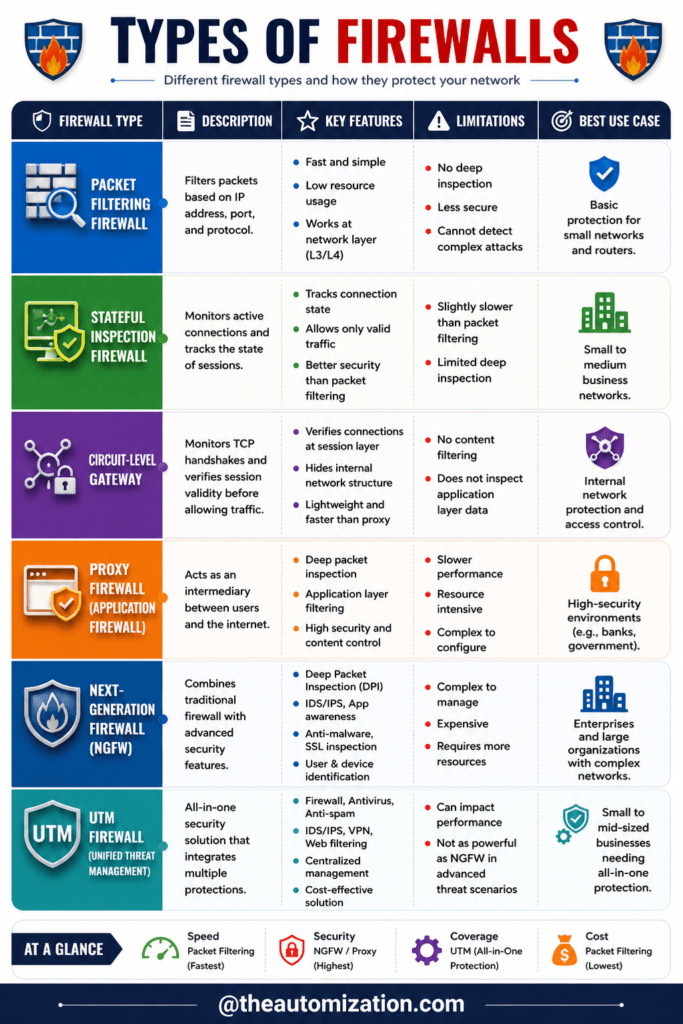
🔍 Packet Filtering Firewall
hecks basic info like IP and ports. Fast, but not very smart.
🔗 Circuit-Level Gateway
Checks if connections follow proper rules.
🧠 Stateful Firewall
Remembers active connections and makes smarter decisions.
🧬 Application-Level Firewall (Proxy)
Acts as a middleman and checks data deeply.
🚀 Next-Generation Firewall (NGFW)
Combines everything + advanced threat detection.
🌍 Cloud Firewall
Protects cloud apps and systems.
🔄 UTM Firewall (All-in-One)
Includes antivirus + firewall + monitoring in one system
Here’s something interesting…
👉 A firewall doesn’t just block incoming traffic.
It also controls outgoing traffic.
Meaning:
If malware somehow enters your system…
A good firewall can stop it from sending data out (like passwords or files).
💡 That’s why firewalls are not just defensive — they’re also monitoring tools.
❌ Common Mistakes Beginners Make
Let’s save you from trouble 👇
- “I have antivirus, I don’t need firewall”
👉 Wrong. Both do different jobs.
- Leaving all ports open
👉 That’s like leaving all doors unlocked.
- Ignoring firewall alerts
👉 Sometimes those pop-ups are warning you of real threats.
- Not updating firewall rules
👉 Hackers evolve. Your rules should too.
⚡ Quick Recap
Firewall = Security barrier between you & internet
Blocks harmful traffic, allows safe traffic
Works using predefined rules (ACL)
Two main types: Host-based & Network-based
Essential for both individuals & organizations
🚀 Final Thought (Don’t Ignore This)
You may never see your firewall working…
But every second…
It’s silently protecting you from attacks you didn’t even know existed.
👉 In cybersecurity, the best defense is the one you never notice.
So the real question is:
Is your firewall strong enough… or are you just lucky so far?