
Imagine this.
You’re not just standing inside a factory anymore…
You’re standing inside a smart factory.
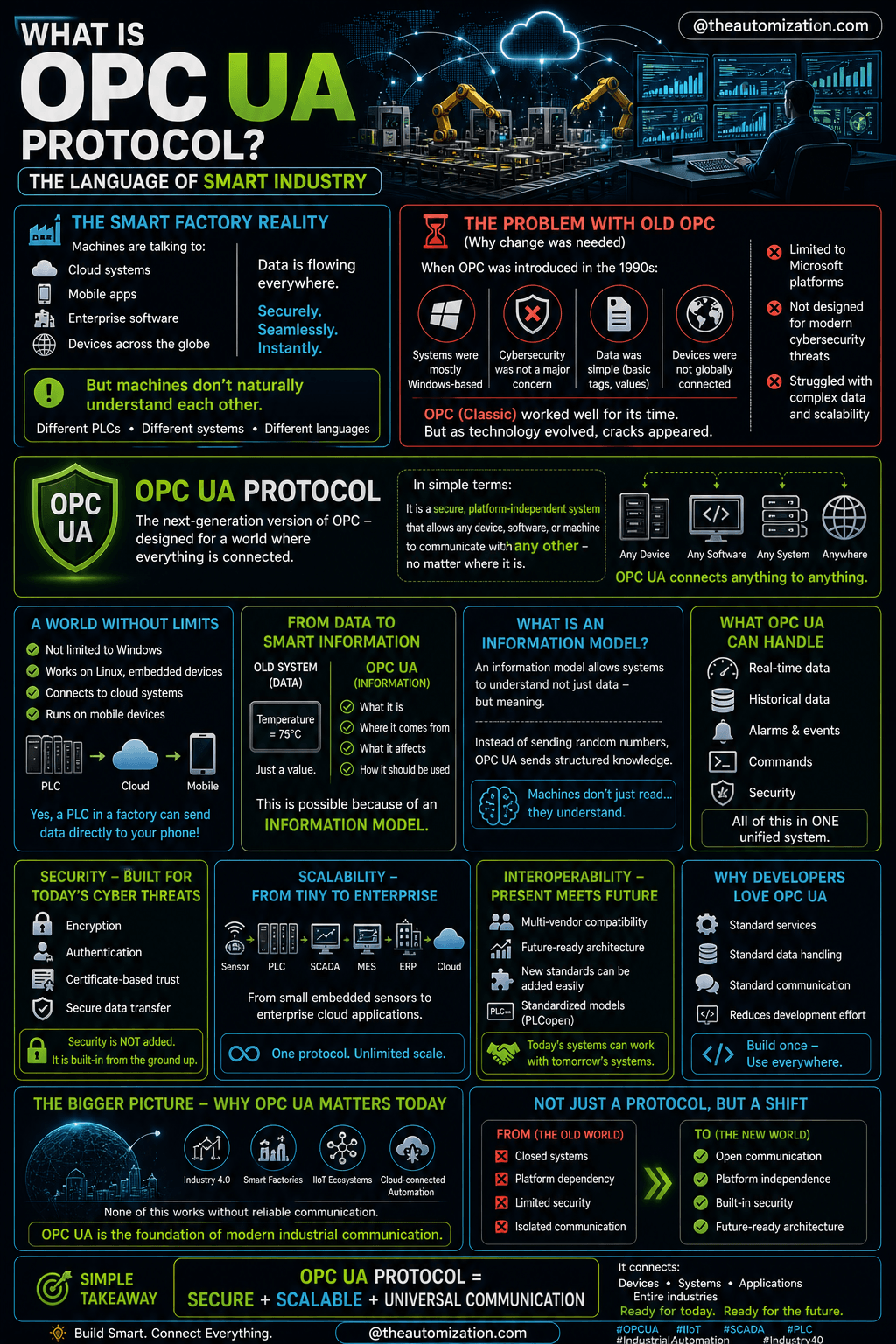
Machines are not only talking to each other — they are talking to cloud systems, mobile apps, enterprise software, and even devices in completely different countries.
Data is flowing everywhere.
Securely. Seamlessly. Instantly.
But if you rewind back to the 1990s…
Things were very different.
⏳ The Problem With Old OPC (And Why Change Was Needed)
When OPC was first introduced in the 1990s, the world looked nothing like today.
At that time:
Systems were mostly Windows-based
Cybersecurity was not a major concern
Data was simple (basic tags, values)
Devices were not globally connected
OPC (Classic) worked well for its time. But as technology evolved, cracks started to appear.
👉 It was limited to Microsoft platforms
👉 It was not designed for modern cybersecurity threats
👉 It struggled with complex data and scalability
And that’s where the next big question started to emerge:
👉 What is OPC UA Protocol and why is it replacing everything?
🧠 What is OPC UA Protocol (In Simple Terms)
Let’s break it down in the simplest way possible.
OPC UA is the next-generation version of OPC — designed for a world where everything is connected.
If someone asks:
👉 What is OPC UA Protocol?
You can answer:
👉 It is a secure, platform-independent system that allows any device, software, or machine to communicate with any other — no matter where it is.
🌍 A World Without Limits
One of the biggest breakthroughs of OPC UA is this:
👉 It removes platform dependency.
That means:
It is NOT limited to Windows
It works on Linux, embedded devices, cloud systems
It can even run on mobile devices
Yes, imagine this:
👉 A PLC in a factory sending data directly to your phone 📱
That’s not futuristic anymore — that’s OPC UA.
When people try to understand what makes OPC UA Protocol so powerful, this is the answer:
👉 It connects anything to anything.
🔄 From Simple Data to Smart Information
Old systems only focused on data.
OPC UA focuses on information.
And there’s a big difference.
Instead of just sending a value like:
👉 Temperature = 75°C
OPC UA can also tell:
What that temperature represents
Where it comes from
What it affects
How it should be used
This is possible because of something called an Information Model.
🧩 What is an Information Model (And Why It Matters)
An information model allows systems to understand not just data — but meaning.
Think of it like this:
Instead of sending random numbers, OPC UA sends structured knowledge.
And this is one of the key reasons why people searching for what is OPC UA Protocol eventually realize:
👉 It’s not just communication — it’s intelligent communication.
⚙️ What OPC UA Can Handle (Just Like Classic — But Better)
OPC UA didn’t just replace OPC Classic.
It absorbed everything good from it and made it future-ready.
It still supports:
✔ Real-time data
✔ Historical data
✔ Alarms and events
✔ Commands
✔ Security
But now, it does all of this in a single unified system.
🔐 Security — Built for Today’s Cyber Threats
Let’s be real.
Today’s world is full of cyber risks.
And industrial systems are no exception.
That’s why OPC UA was designed with security at its core.
It includes:
Encryption
Authentication
Certificate-based trust
Secure data transfer
So when someone asks:
👉 What makes OPC UA Protocol different from older systems?
The strongest answer is:
👉 Security is not added — it is built-in from the ground up.
🚀 Scalability — From Tiny Devices to Enterprise Systems
Another powerful feature of OPC UA:
👉 It works everywhere.
From:
Small embedded sensors
PLCs and controllers
SCADA systems
MES and ERP systems
Cloud platforms
All the way to enterprise-level applications.
This is why OPC UA is considered a scalable communication standard.
🤝 Interoperability — Present Meets Future
One of the biggest advantages of OPC UA is:
👉 It is designed for the future.
This means:
Today’s systems can work with tomorrow’s systems
New standards can be added easily
Different vendors can work together
A great example of this is collaboration with organizations like PLCopen.
They are building standardized models for PLC programming using OPC UA.
So instead of isolated systems, we now have shared ecosystems.
💡 Why Developers Love OPC UA
There’s another hidden benefit most people don’t talk about.
👉 It reduces development effort.
Since OPC UA provides:
Standard services
Standard data handling
Standard communication
Developers don’t have to reinvent everything again and again.
👉 Build once — use everywhere.
🌐 The Bigger Picture — Why OPC UA Matters Today
If you step back and look at the bigger picture…
You’ll realize something important.
We are moving towards:
Industry 4.0
Smart factories
IoT ecosystems
Cloud-connected automation
And none of this works without reliable communication.
That’s exactly where OPC UA fits in.
So when people ask:
👉 What is OPC UA Protocol in today’s world?
The real answer is:
👉 It is the foundation of modern industrial communication.
🎬 Final Thought — Not Just a Protocol, But a Shift
OPC UA is not just an upgrade.
It’s a complete shift in how systems interact.
From:
❌ Closed systems
❌ Platform dependency
❌ Limited security
To:
✅ Open communication
✅ Platform independence
✅ Built-in security
✅ Future-ready architecture
🎯 Simple Takeaway
If you want to remember this forever, just keep this in mind:
👉 OPC UA Protocol = Secure + Scalable + Universal Communication
It connects:
Devices
Systems
Applications
And even entire industries
And it does it in a way that is ready not just for today…
👉 But for the future.